Incredible Jamaica · An integrated housing proposal
Addressing Jamaica’s need for affordable homes.
Incredible Jamaica is developing an integrated housing proposal that brings together homes, protected food production, solar energy and water infrastructure.
The aim is to widen access to homeownership while creating opportunities to earn from agriculture and manage essential household costs.
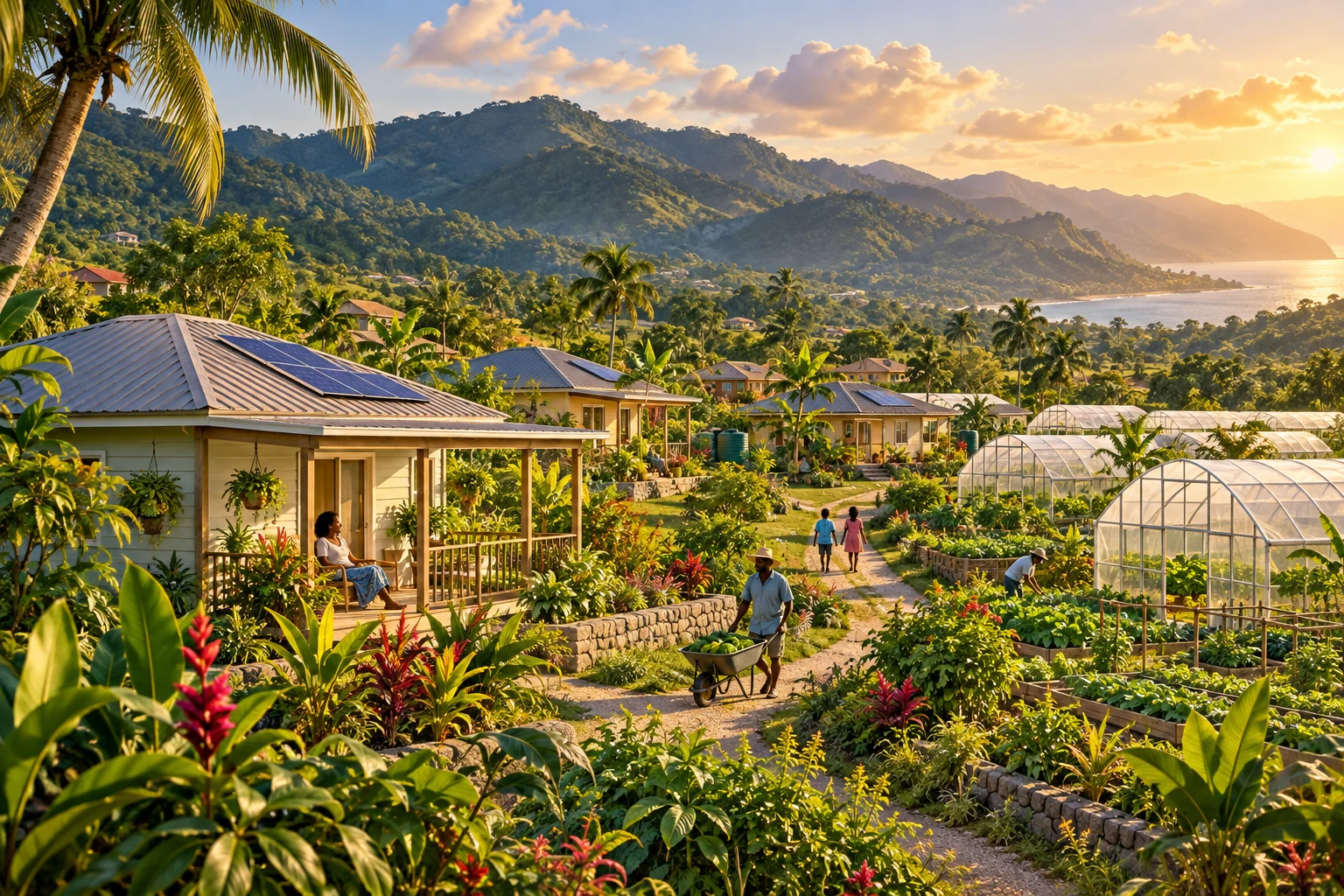
Concept illustration. Not an actual site or approved design.
What
Homes linked to protected growing, solar and water services
Who
Homebuyers and willing growers; participation terms to be agreed
Where / stage
Jamaica · Feasibility; site control and pilot size unconfirmed
Next step
Site evidence, costed operating plan and NHT programme-fit discussion
No construction date is set. Homes are not yet for sale.
01 / The need
A home must be affordable to live in, as well as to buy.
Jamaica needs more homes that households can afford. NHT identifies a gap between housing demand and supply in its own development programme. Our proposal addresses the cost of a home alongside income-generating agriculture and the energy and water services needed for daily life. [3]
Buying and running a home
A purchase price must fit the buyer’s deposit and confirmed borrowing capacity. Mortgage payments, insurance, utilities, maintenance and estate charges must also leave enough for daily living.
Jamaican context: the Government’s June 2025 announcement provides up to J$12m for a single NHT applicant buying a home priced at J$14m or less. [1]
Earning from food production
A greenhouse needs a capable grower, suitable crops and paying buyers. Revenue must cover inputs, labour, asset charges, crop losses and replacement costs before it becomes household income.
Jamaican precedent: the World Bank’s REDI account describes greenhouse growers in Content, Manchester, supported by training, irrigation and links to hotel buyers. This is another project’s experience. [2]
Reliable energy and water
Homes and farms need different service levels. Water storage, irrigation, drainage, solar and backup power must be sized and maintained for their actual use.
Jamaican context: the 2025 SMART Energy announcement includes solar, battery storage and rainwater harvesting. [1]
Affordability means the whole household budget: the deposit, mortgage and ongoing costs must fit verified income and available finance, leaving room for daily living. The buyer income band, deposit and mortgage terms must be established before a price is described as affordable; projected farming income is not confirmed mortgage income.
02 / Who it is for
Homes for households. Growing enterprises for willing operators.
Intended residents
The current planning focus is households seeking to buy a home through an affordable mortgage route, including eligible NHT contributors. The income band, deposit capacity and buyer eligibility criteria are not yet agreed.
Intended growers
Willing growers would run the greenhouses with agronomy, training and marketing support. A home purchase is not being presented as an obligation to farm: resident participation and eligibility for non-resident growers still need agreement.
Shared services
A designated estate or service operator would maintain shared water, energy and common areas. The operator, asset ownership and charges are not yet agreed; residents and growers are distinct from the organisations delivering these services.
03 / What is proposed
A home and a productive growing unit, planned together.
The proposed “1+1” model links housing and agriculture: one home linked to one greenhouse. The working greenhouse size is 8 × 30 metres (240 m²). This is a planning basis, not an approved specification or sales package.
The working arrangement is for a separate agricultural asset owner to fund the greenhouse and make it available to a grower for a charge. This could keep the productive asset outside the residential mortgage. Ownership, charges and grower rights are proposals, not signed arrangements.
The physical plan would need homes, growing areas, irrigation and water storage, access and drainage, solar where justified, and space for nursery, packing and produce handling. Agronomy, maintenance and sales support connect the facilities into an operating business.
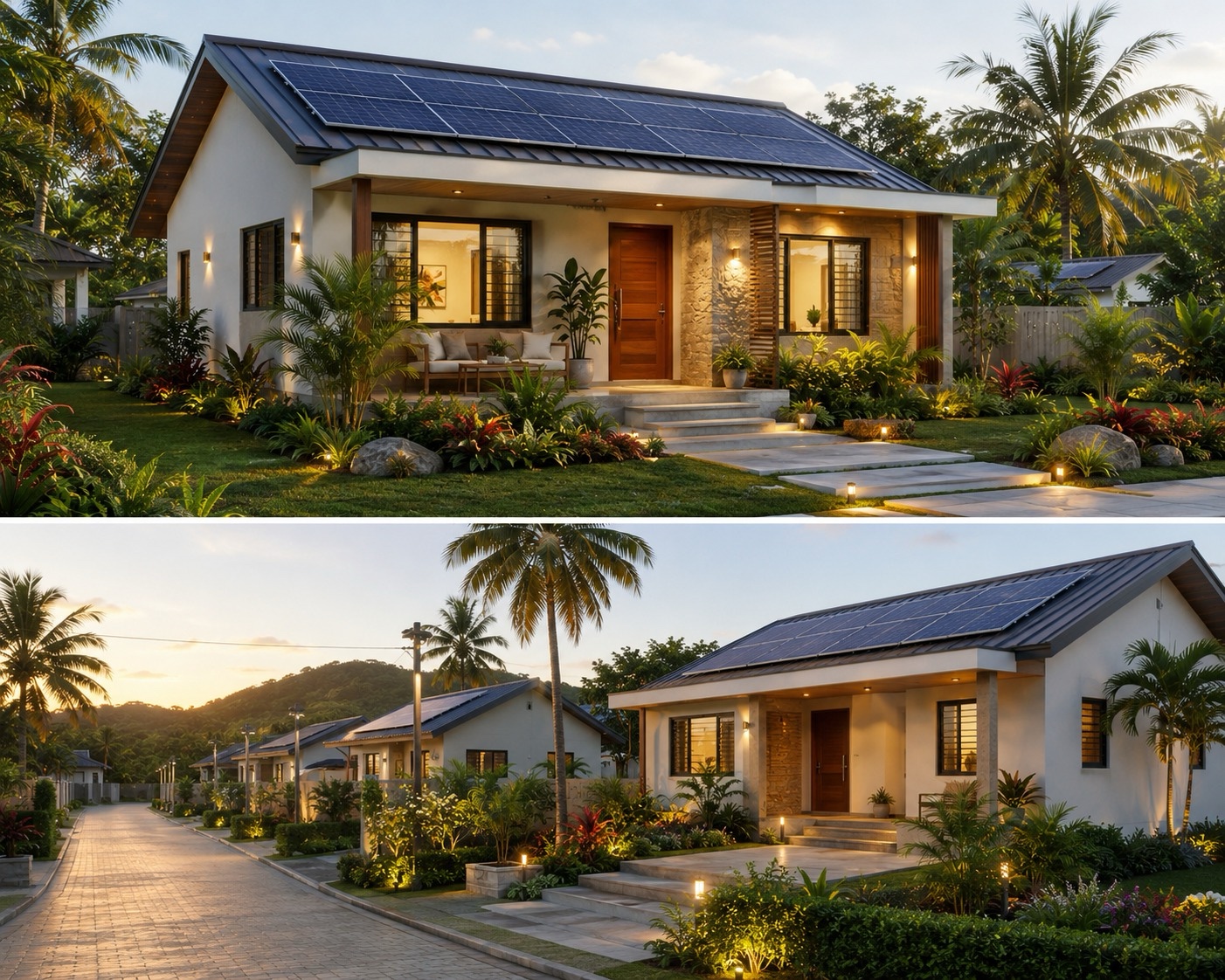
Concept homes only. Not a confirmed site, approved design or completed development.
04 / Where and when
Project status and next milestones.
Site control, planning approvals and the first-phase scope remain to be confirmed. NHT participation, purchaser finance and produce-purchase arrangements are not secured. Homes are not currently offered for sale.
The financial model includes pilot and larger-scale scenarios. These are feasibility cases, not an agreed construction programme or evidence of future farming income.
1. Site and buyer evidence
Confirm landowner authority, title, survey, access, planning constraints, water and local buyer demand. This determines whether a pilot can fit and who it could serve.
2. Costed operating plan
Obtain construction and infrastructure costs, test household affordability, and agree a greenhouse operating proposal with realistic crop and buyer evidence.
3. Approvals and funding
Set responsibilities, secure the required permissions and finance, and agree contracts before committing to construction. A programme follows these decisions.
The development review calls for crop, cost and customer evidence before expansion. No timetable is promised while those dependencies remain open.
05 / How it would work
Separate responsibilities. Connected delivery.
Element
Proposed payment and ownership
Who operates it / what remains open
Land and planning
A purchase, lease or land partnership would establish control. Land price, early professional costs and funding are not agreed.
Landowner, legal adviser and planning team. Title, mandate, survey, access and approvals route must be established.
Homes and construction
A developer would fund construction; buyers would purchase with deposits and approved mortgage finance. Home sales are modelled; no rental arrangement is agreed.
Appointed developer, builder and professionals. Designs, costs, title arrangements, funding and purchaser terms remain open.
Greenhouses and crops
The working option is separate agricultural ownership, with growers paying an asset charge and service fees. Equipment finance, grower working capital and charges are not agreed.
Growers supported by an agricultural operator. Crop plans, agronomy, packing, marketing and buyer contracts must be established.
Energy, water and common areas
Separate budgets for household, farm and shared assets. Capital funding, ownership, metering and recurring charges must be allocated.
Specialist providers and an estate/service manager. Maintenance standards, reserves, tariffs and appointments remain open.
NHT and other finance routes are being assessed. Project-specific agreements are required for any mortgage, development loan, bulk housing purchase or produce sale.
The promoter’s role: developing the proposal, testing its economics and assembling the delivery team. The current work includes an integrated financial model and a review of Jamaican housing-finance routes, building on the earlier housing-and-farming model. Delivery would be undertaken by appropriately appointed Jamaican professionals and operating organisations.
06 / The next conversation
Discuss the proposal’s fit with NHT.
We welcome an initial discussion with the National Housing Trust about how this integrated housing proposal could meet contributor needs and what evidence would be required for further consideration.
Households and affordability
Discuss the intended buyer profile, acceptable housing costs, eligibility and the treatment of household income and recurring charges.
Development route
Establish which NHT route, if any, could fit the eventual land arrangements and delivery structure. Housing finance and agricultural assets need separate consideration.
Evidence for consideration
Clarify the required site information, designs, infrastructure scope, cost plan and developer capability before a formal proposal progresses.
Practical inputs needed to progress
Land evidence: an owner-authorised proposal with location, title, survey, access and utility information.
Construction costing: a quantity-surveyor cost plan separating homes, civil works, utilities, fees and contingency.
Agricultural proposal: greenhouse specification, growers, crops, training, working capital, operating charges and prospective buyers’ requirements.
Service budgets: energy and water demand, infrastructure design, ownership, maintenance and recurring charges.
The next useful NHT conversation is about buyer affordability, programme fit and the information needed for consideration. Supporting proposals should state assumptions, exclusions and the evidence behind costs.
Investment discussions will use a separate pitch deck and supporting financial information. This website is not an investment offer.
Project & Partnership Overview
Take the outline with you.
Eight sections covering the development proposal, household needs, project status and the route to further discussion. This remains a discussion document, not an investment or housing offer.
For NHT and other institutional enquiries, tell us your role, the part of the proposal you would like to discuss, and the information needed for an initial review.
Please keep an initial message brief. Land documents, financial records and other confidential material should be discussed through an agreed channel.
Project enquiries
Introduce your organisation and the part of the proposed development you would like to discuss.